
How to Calculate Customs Duty When Importing from China: A 2026 Guide
Sep 29, 2026
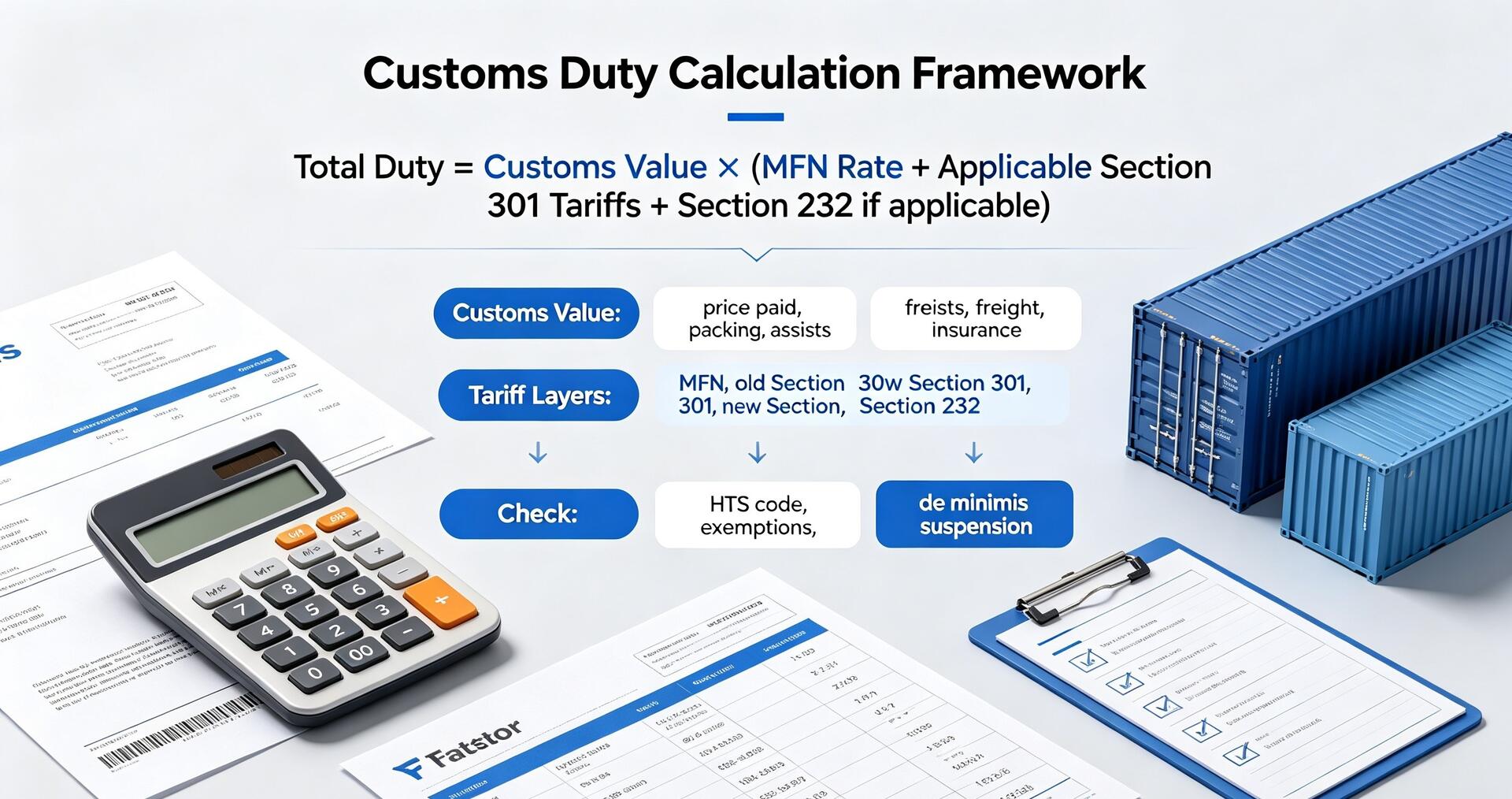
Shenzhen, Guangdong Sep 28, 2026 (Issuewire.com) - Calculating customs duty when importing from China (https://www.transworldcn.com/service/customs-Insurance/) requires more than applying a percentage to the supplier's invoice. For a U.S. shipment, classification, valuation, additional tariff measures and any applicable exclusions affect the calculation. This framework is adapted from TransWorld (https://www.transworldcn.com/About-us/) and retains the source guide's step-by-step approach. Its policy dates, tariff figures and valuation assumptions are source-reported references, not an independently verified customs ruling. Confirm the measures in force for the product and entry date with a licensed customs broker before filing or using the figures for a binding landed-cost estimate. Step 1: Identify the U.S. HTS Code The guide starts with the complete 10-digit U.S. Harmonized Tariff Schedule code rather than a supplier's Chinese code alone. The first six HS digits are internationally standardized; additional digits provide the destination's further classification. Its roasted-coffee example breaks the structure into four levels: chapter 09 covers coffee, tea and spices; heading 0901 covers coffee; subheading 0901.21 identifies roasted, non-decaffeinated coffee; and the guide assigns 0901.21.0010 to containers of no more than two kilograms. Treat this as the source's example and verify the actual classification before making an entry. The original resource table identifies the USITC HTS database for official U.S. classifications and rates, Tariff Check for tariff searches, and the Flexport Tariff Simulator for calculations involving Section 301 and Section 232. A search result is not a substitute for checking the product's material, function, specifications and intended use with a broker. Step 2: Find the Base MFN Rate After classification, identify the base Most Favored Nation rate, described in the guide as the standard rate for imports from WTO members, including China. The workflow directs readers to Column 1, Normal, in the applicable HTS entry. Rates can take different forms. An ad valorem duty is a percentage of value, such as 3.2%. A specific duty is an amount per unit, such as US$0.32 per kilogram. A combined rate contains both elements. The source uses woodworking machinery under 8465.92.00 with an approximately 3.2% rate as an illustration; that classification and rate require confirmation for the actual goods. Step 3: Assess Section 301 Measures The source guide separates Section 301 into two reported layers. It lists older measures associated with Lists 1-4 at 7.5-25%, varying by product, and describes a further 12.5% forced-labor measure with a July 24, 2026 effective date. It says the latter applies to China, Vietnam and 41 other economies and is additive to the older layer. These are claims made by the source guide, not verified policy findings in this adaptation. Establish the applicable notice, product coverage, entry date and any exclusion before using either figure. The guide's illustrative arithmetic combines a 25% older layer with a 12.5% additional layer to obtain 37.5%, before adding MFN duty. For a power adapter labeled 8504.40.85, it assumes MFN of 2.5%, an older Section 301 rate of 25% and a further 12.5%, producing a 40% example total. This is an explanation of the source's assumptions, not a confirmed duty determination for all adapters. Step 4: Check Section 232 and Other Product Measures The original product-category comparison lists steel and aluminum at 25% under Section 232, vehicles and parts at up to 25% under its stated Section 301 automotive treatment, and copper at 25% under a Section 232 measure it dates to 2025. The source also says its additional 12.5% measure does not stack with Section 232, while its later workflow refers more broadly to 25-50% Section 232 duties for metal and automotive goods. These statements need product-specific reconciliation. Do not assume that every listed tariff can simply be added together or that every metal-containing article receives the same treatment. Step 5: Review Exclusions The guide reports a November 29, 2026 deadline for certain Section 301 exclusions and names some electronics, components, medical supplies, industrial machinery and solar-manufacturing equipment as examples of relevant categories. It describes an excluded product as avoiding the Section 301 layer. Confirm the precise exclusion wording, classification, product description, effective period and remaining applicable measures rather than assuming that a broad category label establishes eligibility. The guide directs readers to the current USTR exclusion list. Step 6: Establish the Customs Value The source guide cites 19 U.S.C. § 1401a and presents a list of valuation components. It includes the goods' purchase price, packing, commissions described as selling commissions involving a buyer's agent, assists such as buyer-provided materials or tools, royalties that are conditions of sale, and freight and insurance. It excludes advertising costs and the buyer's internal expenses. The treatment of freight, insurance and commissions is a material assumption in that source list and must be confirmed for a U.S. entry. The list is reproduced here in prose to explain the original framework, not to certify that every listed cost belongs in every transaction value. The guide warns against false invoices, using one true invoice and another reduced invoice for customs, and omitting required additions. It describes possible consequences including back duties, civil penalties, loss of trusted-trader status and criminal prosecution. Maintain accurate records rather than treating undervaluation as a cost-saving method. Step 7: Check Low-Value and Postal Treatment The source reports suspension of the US$800 de minimis exemption from August 29, 2025. It also describes postal charges using three country-tariff bands: US$80 per item below 16%, US$160 at 16-25%, and US$200 above 25%. Those figures and their period of application require confirmation before use. The guide distinguishes postal items from commercial shipments, for which it says applicable duties must be assessed regardless of value. Do not infer current eligibility, procedure or charges solely from a parcel being worth less than US$800. Step 8: Calculate the Example Duty For a shipment subject to compatible ad valorem measures, the source's approach multiplies customs value by the applicable combined rate. Its illustrative expression adds MFN, applicable Section 301 measures and Section 232 where applicable. The non-stacking discussion above means applicability must be checked before combining layers; specific or combined duties also require their relevant units. The worked power-adapter example assumes a US$10,000 CIF value, which the source treats as customs value including freight and insurance. Under its assumed rates, the calculation is: MFN: US$10,000 multiplied by 2.5% produces US$250. Older Section 301 layer: US$10,000 multiplied by 25% produces US$2,500. Additional layer described by the guide: US$10,000 multiplied by 12.5% produces US$1,250. Illustrative total: US$4,000, equivalent to 40% of the assumed value. The arithmetic follows those inputs. It does not independently establish the correct classification, dutiable value, effective tariff measures or payable amount for a real shipment. Avoid the Most Common Calculation Mistakes The guide highlights five recurring risks: substituting a Chinese code for the complete U.S. HTS classification; using an invoice without reviewing valuation requirements; overlooking additional tariff measures; failing to examine relevant metal or automotive treatment; and assuming low-value shipments automatically qualify for duty-free entry. A repeatable workflow addresses these risks in order. Identify the product and its composition, establish the full classification, record the base rate, review Section 301 measures and exclusions, assess other relevant product measures, determine the proper value, and then calculate the applicable duties. Retain the supporting classification, value and rate information with the shipment records. Frequently Asked Questions Can a supplier's Chinese HS code be used unchanged? Not automatically. The source explains that the first six digits share the international HS structure, while U.S. duty calculations require the appropriate complete U.S. classification. Verify the remaining detail for the product. Is there one Section 301 rate for all Chinese products? No single figure should be assumed from the guide's examples. Its stated older rates, reported additional layers and exclusions need to be matched to the product and effective period. Does an exclusion remove every import charge? Do not make that assumption. Confirm what the exclusion covers and review the other applicable duties and charges separately. A category description alone is insufficient. Is the supplier's invoice the entire valuation analysis? The guide's central point is that valuation requires a review of relevant components. Its specific treatment of freight, insurance and commissions needs confirmation before a declaration is prepared. Is there an Incoterms 2026 edition? The source guide identifies Incoterms 2020 as the official edition and says a later revision is expected around 2030. That future timing is a source statement, not a confirmed publication schedule in this adaptation. Build the Estimate on Confirmed Inputs Classification, exclusions and accurate valuation are the foundations of a usable duty estimate. Check the rules applicable to the shipment rather than relying on a generic tariff percentage or an unverified example. A small classification or valuation error can change costs and expose the importer to further scrutiny. For information about shipment services and customs-related enquiries, visit the TransWorld official website (https://www.transworldcn.com/).
Source :Shenzhen Transworld Supply Chain Co., LTD.
This article was originally published by IssueWire. Read the original article here.
More News

The Palm Beaches are Having a Moment: Discover What’s New in 2027
The Palm Beaches continue to build on their momentum, giving visitors fresh reasons to return and new experiences to discover with every visit. After welcoming 6.09 million visitors in the first half of 2026, up 6.4% from 2025, The Palm Beaches are building on this success with a pipeline of approximately $500 million in developments set to further strengthen the tourism economy. Across 39 cities and towns, the next wave of openings and experiences is taking shape, making the destination an even more compelling place to visit in the year ahead.

KENNEDY SPACE CENTER VISITOR COMPLEX POWERS UP FOR MAX POWER
Visitors to Florida’s Kennedy Space Center Visitor Complex can celebrate the innovation, people and legacy behind NASA’s greatest achievements during MAX POWER, an extra-special event taking place 6 – 8 November 2026. The exhibits and experiences at Kennedy Space Center Visitor Complex celebrate NASA’s great achievements: past, present, and future. During MAX POWER, guests will go on an extraordinary journey as the visitor complex further transforms into a showcase of human ingenuity.

Save Up to 20% on Bangkok–Kuala Lumpur with Vietjet Thailand & Tourism Malaysia
Vietjet Thailand is strengthening its presence in ASEAN’s short-haul travel market through collaboration with Tourism Malaysia to support and promote the ‘Visit Malaysia 2026–2027’ campaign, with the aim of encouraging greater travel connectivity and increasing Thai visitor arrivals to Malaysia. The partnership aims to encourage Thai travellers to visit Malaysia during the year-end peak travel season, expand travel options to one of their most popular destinations, and support tourism growth between the two countries.

Why do some celebrity perfumes – think Ariana Grande, Britney Spears – stay popular?
There is a particular kind of deja vu that comes from a stranger’s perfume, when a scent – sugary-sweet in a lift, soft and creamy on a person’s jumper, flowery from a hug – drifts past and you know it long before you can name it. Chances are, a few of them come with a celebrity’s name. Famous names have long sold perfumes, intentionally or not. When Marilyn Monroe said in 1952 that Chanel No 5 was all she wore to bed, she did more for that bottle than any advertisement could, despite never...

Royal Enfield commits over INR 3 crore to snow leopard conservation
Royal Enfield has pledged over INR 3 crore towards snow leopard conservation, fulfilling a commitment made during its One Ride 2026 event. The funding will support habitat protection, scientific research, community stewardship and human-wildlife conflict mitigation across more than 10,500 sq. km of snow leopard habitat in six Himalayan regions. The initiative also includes a nature interpretation centre in Ladakh and a conservation conclave.

29 Multi-Tasking Beauty Products To Help You Save Space In Your Carry-On
Why pack a separate blush, highlighter, eyeshadow, and bronzer when you can have it all in *one* teeny palette? View Entire Post ›

How Confucius’ teachings about morality still apply today and what we can learn from them
We recently hosted visitors from Malaysia at our place in the Czech Republic, happily guiding them around Prague and several places beyond the capital, including a few that were new to us, too. There was much conviviality as the six of us explored beautiful Czech cities and towns, sampled hearty local cuisine and slipped effortlessly into the distinctive Malaysian-Singaporean patois – a lively hybrid of English, Chinese, Malay and some Indian vocabulary and syntax – that comes naturally to many...

How to Style like Sofia Coppola, Chloé Zhao, Greta Gerwig and Emerald Fennell
These celebrated female filmmakers have been owning the spotlight of late with their distinctive fashion choices – Sofia Coppola’s understated minimalism and Greta Gerwig’s smartly tailored ensembles haven’t gone unnoticed. Read on to explore the personal style of four of Hollywood’s best-dressed women directors. Sofia Coppola Rabanne skirt The Row T-shirt Chanel necklace Cartier watch Max Mara shoes (HK$5,990) Chloé Zhao Toteme jumper Malo shirt Phoebe Philo trousers Hermès...

How procrastination can harm your physical and mental health, and practical tips to stop it
“Have you made that doctor’s appointment about the lump on your back yet?” your spouse asks. You sheepishly mumble that you have not. Walking past a packed wardrobe – a daily reminder of a decluttering project put off for months – you settle onto the sofa to finish binge-watching that new Netflix series. Sound familiar? Procrastination is no big deal; everyone puts off tasks they don’t want to do, right? Wrong, according to Fuschia Sirois, a professor of social and health psychology at Durham...

Inside NBA star Trae Young’s US$700,000 watch collection, from Rolex to Hublot
Four-time NBA All-Star Trae Young has a watch collection as impressive as his basketball career. The 28-year-old, who signed a four-year US$212 million deal with the Washington Wizards in June this year, sat down with Robertino Altieri, CEO and founder of second-hand luxury watch dealers, WatchGuys, in an exclusive episode of Altieri’s video series, My Collection, to talk about his stunning watch rotation valued at around US$700,000. Young’s love for timepieces started when he was only 10,...

Meet Wicker star Marli Siu, who was born in Hong Kong
One of the most highly anticipated films of 2026 is Alex Huston Fischer and Eleanor Wilson’s Wicker. Starring Olivia Colman and Alexander Skarsgård, it follows a lonely fisherwoman who commissions a weaver to make her a husband out of wicker, only for the creation to come to life, sparking an enviable romance. The cast includes Peter Dinklage as the Basket Weaver, Elizabeth Debicki as the Tailor’s Wife and Marli Siu as the Bottle-Washer’s Wife. View this post on...

"You’d Best Get The Hell Out Of This Town": 34 Really, Really, Really, REALLY Disturbing Small Town Stories That Will Make You Stay Home For The Rest Of Your Life
"We reversed out of there as quickly as we could, screaming and certain that we just stumbled upon something we shouldn’t have." View Entire Post ›
Recommended









YOUR NEWS, OUR NETWORK.
Do you have Great News you want to tell the world?
Be it updates about your business or your community, you can make sure that it’s heard by submitting your story to our network reaching hundreds of news sites across 6 verticals.